Richmond Park
Academy
Courses for adults
- B Intermediate level B1 B2
Course overview
Whether you are learning English for work, study, travel or personal progress, our adult courses give you a clear path forward. We combine structured teaching, practical communication and focused exam preparation, helping you build confidence at every stage and work towards the Cambridge English qualification that best matches your level.
For adult learners, the most natural Cambridge pathway begins with A2 Key and progresses through B1 Preliminary, B2 First, C1 Advanced and C2 Proficiency.

B1 Preliminary
Practical English for everyday life, travel and greater independence.
Summary: At B1 Preliminary, learners move beyond the basics and develop practical language skills for everyday use. This level helps adults read simple articles and texts, write emails and messages on familiar topics, understand factual information, and communicate with more confidence in day-to-day situations. Cambridge positions B1 Preliminary as the step between A2 Key and B2 First, and its standard version is designed for adults.
Ideal for: adults who want a solid intermediate level.
B1 Curriculum Overview

At B1 Preliminary, learners have now mastered the basics of English and have practical language skills for everyday use. Learners at this level can read simple textbooks and articles in English, write letters and emails on everyday subjects, understand factual information, and show awareness of opinions and mood in spoken and written English. This means the curriculum shifts from basic survival English towards more independent use of English across everyday, study and work-related contexts.

In reading, this level requires learners to work with signs, messages, short texts, longer texts, gapped texts, vocabulary cloze tasks and open cloze tasks. This exam paper shows that candidates can read and understand the main points from signs, newspapers and magazines, and it also includes tasks that test understanding of text structure and coherence. So the B1 curriculum includes reading for gist and detail, recognising the main point of a text, building awareness of how paragraphs and ideas connect, and strengthening vocabulary and grammar through contextual reading tasks.

In writing, at B1 level the students must write about 100 words in an email and then choose between writing an article or a story. The writing paper shows candidates can use vocabulary and structure correctly. So the curriculum includes writing functional emails, organising short texts clearly, using appropriate everyday vocabulary, and developing enough control of grammar and structure to write coherent, purposeful texts. Learners should move beyond short notes into fuller paragraph-based writing.
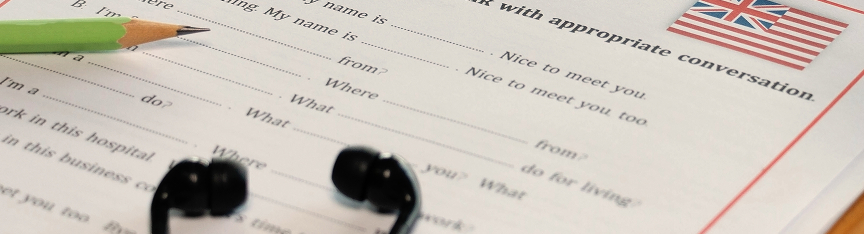
In listening, learners now need to follow a range of spoken materials including announcements and discussions about everyday life. The listening tasks require learners to identify key information in short monologues or dialogues, understand the gist of short dialogues, complete notes from a monologue, and listen to an interview for detailed meaning, attitudes and opinions. A B1 curriculum therefore includes listening for gist, detail and specific information, while also beginning to train learners to notice attitude, opinion and mood in spoken English.

In speaking, the B1 format requires candidates to give personal information, describe a photograph for about one minute, discuss alternatives, negotiate agreement, and talk about likes, dislikes, habits, experiences and opinions. That means the curriculum should develop more sustained speaking than at A2: not just short answers, but picture description, simple comparison, expressing preferences, making suggestions, and taking part in pair discussion.

In practical curriculum terms, B1 Preliminary focus on:
- understanding the main points and structure of straightforward texts
- writing clear everyday emails and short extended texts
- improving grammatical control and range for practical communication
- listening for gist, detail, attitudes and opinions in familiar contexts
- speaking in longer turns and taking part in simple discussion and negotiation.
B2 First
Summary: Confident, effective English for professional and international settings.
At B2 First, learners develop the language skills needed to communicate confidently in an English-speaking environment. This includes expressing opinions clearly, presenting arguments, following the news, and writing detailed texts such as emails, articles and reviews.
This level (B2 First) is designed for adults in its standard version and sits between B1 Preliminary and C1 Advanced.
Ideal for: professionals, university-bound learners, and adults aiming for fluent independent use of English
B2 Curriculum Overview

At B2 First, learners have the language skills to live and work in an English-speaking country or study on courses taught in English. In addition, learners at this level can communicate effectively face-to-face, expressing opinions and presenting arguments, follow the news, and write clear, detailed English, including emails or letters, articles, reviews and other types of text. So the curriculum at B2 moves from practical independence to confident, flexible communication in more demanding academic, professional and social contexts.
In reading and use of English, the curriculum combines comprehension with language control. Learners work with a wide range of text types, including newspaper and magazine articles, reports, fiction, advertisements, letters, messages, brochures, guides and manuals. The paper also explicitly tests vocabulary and grammar through multiple-choice cloze, open cloze, word formation and key word transformations, while reading tasks require understanding detail, opinions, attitudes, text structure and locating specific information. A B2 curriculum therefore includes substantial work on lexical development, collocation, phrasal verbs, word-building, sentence transformation, and reading longer authentic-style texts with close attention to viewpoint, cohesion and structure.
In writing, students write an essay in Part 1 and then choose a second text type in Part 2, such as an article, email or letter, review, and for B2 First specifically a report. Here, learners need to advise, compare, describe, explain, express opinions, justify and recommend. So the curriculum includes genre awareness, paragraph structure, argument development, register, and the ability to shape writing to purpose and reader.
Compared with B1, learners at B2 need more range, more control, and more ability to support opinions with reasons and examples.
In listening, students must be able to follow and understand a range of spoken materials such as news programmes, presentations and everyday conversations. The tasks require listening for feeling, attitude, opinion, purpose, function, agreement, gist, detail, specific information and main idea. A B2 curriculum therefore includes extended listening, multiple-speaker listening, note completion from longer monologues, and systematic work on inference, speaker attitude and communicative purpose.
In speaking, Cambridge’s B2 format requires candidates to talk about themselves, describe and compare photographs, express and justify opinions, speculate, evaluate options, negotiate with another candidate, and reach a shared decision. This curriculum explicitly highlights skills such as exchanging ideas, agreeing or disagreeing, suggesting, speculating, evaluating and reaching a decision through negotiation. So the curriculum places strong emphasis on interactive speaking, extended turns, discussion management, comparison language, and persuasive or evaluative language.
- understanding longer, more complex texts and the writer’s viewpoint
- expanding grammar and vocabulary range, especially collocation, word formation and transformation
- writing clear, detailed and well-organised texts for different purposes
- listening to longer spoken texts for main idea, attitude, opinion and specific detail
- discussing, comparing, justifying and negotiating ideas with confidence.